Africa Carbon Markets Initiative launched at COP 27 to drive expansion of Africa’s participation in Voluntary Carbon Markets
Building on our earlier analysis on the 27th Conference of Parties (COP27) to the United Nations Framework Convention on Climate Change held in Sharm El-Sheikh, Egypt, we provide an update on an African initiative bound to change climate policy developments on the continent.
Africa Carbon Markets Initiative (ACMI)
A new initiative to promote the growth of carbon credit production and jobs creation across the African continent was launched during the recently concluded COP27. Led by a thirteen-member steering committee of African leaders, CEOs and carbon credit experts, the ACMI was inaugurated with the aim of dramatically expanding Africa’s participation in voluntary carbon markets. This initiative is sponsored by Global Energy Alliance for People and Planet (GEAPP), Sustainable Energy for All (SEforALL), United Nation Economic Commission for Africa (UNECA) and UN Climate Change High-Level Champions.
Purpose
ACMI’s ambition is summarised as follows;
- Produce 300 million carbon credits annually by 2030 and 1.5 billion credits annually by 2050
- Unlock 6 billion in revenue by 2030 and over 120 billion by 2050
- Support 30 million jobs by 2030 and over 110 million jobs by 2050
- Distribute revenue equitably and transparently with local communities
- Support the growth of voluntary carbon markets across the continent through its programs identified in its Roadmap report – “Harnessing Carbon Markets for Africa”
Benefits of Carbon Markets
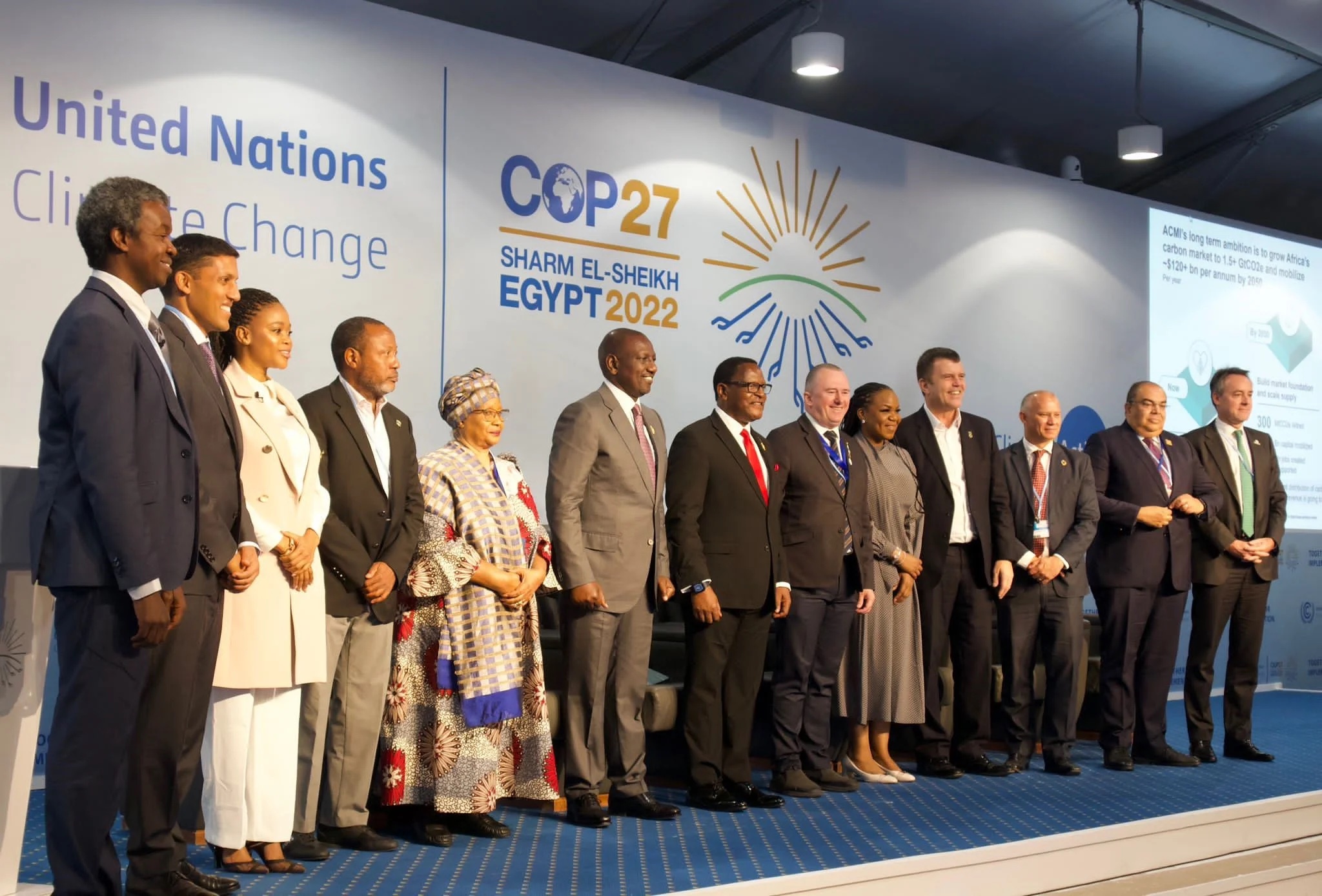
Several African countries including Gabon, Kenya, Malawi, Nigeria and Togo joined the ACMI inauguration to announce their commitment to scaling voluntary carbon markets. Major carbon credit buyers and financiers, such as Exchange Trading Group, Nando’s and Standard Chartered announced ambitious plans to set up an advance market commitment (AMC) for high integrity African carbon credits.
Carbon markets offer an incredible opportunity to unlock billions for the climate finance needs of African economies while expanding energy access, creating jobs, protecting biodiversity and driving climate action. Though, Africa currently produces only a tiny percentage of its carbon credit potential.
ACMI is committed to supporting high-integrity credits where an equitable and transparent distribution of revenue goes to communities. To that end, ACMI is collaborating with global integrity initiatives like the Integrity Council for the Voluntary Carbon Market (IC-VCM) and the Voluntary Carbon Markets Integrity Initiative (VCMI), as well as other regional carbon market platforms.
Carbon credits
A carbon credit is a tradeable permit that represents the right to emit one metric ton of carbon dioxide or other greenhouse gases. Carbon credits trading is one of the many technical interventions used to reduce the amount or concentration of greenhouse gases in the atmosphere.
Types of Carbon Credit Markets
There are broadly two types of carbon credit markets in the world currently – the compliance market and voluntary market. The compliance market allows participants to buy and sell carbon credits or carbon offsets to comply with rules or regulations imposed by regulatory or governance organisations. On the other hand, the voluntary market allows for the trading of carbon credits that are not bought or sold on the compulsory carbon markets to meet the greenhouse gases emissions requirements imposed by regulatory bodies.
Regulatory Framework in Uganda
Section 9 of the National Climate Change Act 2021 provides for participation in climate change mechanisms. These climate change mechanisms among others include; compliance and voluntary emissions trading mechanisms. The Minister of Water and Environment is mandated to make regulations laying down the process for purposes of participating in climate change mechanisms.
The ground work has been put in place with the enactment of the National Climate Change Act 2021. Now is the time for our leaders and policy makers to get to work and implement. Global warming is real, and immediate action is required. Therefore, Uganda should commit to collaborate with ACMI like the other African countries mentioned, to scale carbon credit production, so as to create jobs, drive green investment, protect biodiversity and promote climate action.
Conclusion
Whilst ACMI aims to encourage conversation, coordination and action towards the development of African voluntary carbon markets, the caution from experts is regulation for voluntary markets, which are often unchecked. Stringent policies are required to check on social safeguards to avoid human rights abuses and greenwashing loopholes that some companies exploit to masquerade as eco-friendly without reducing requisite emissions. All in all, it is a good initiative that the continent can work with to unlock the much needed climate finance to drive climate action.
The content of this article is intended to provide a general guide to the subject matter. Specialist advise should be sought about your specific circumstances.